If you spend any time browsing Australian Shepherd breeder websites, you will see the phrase health tested on almost every single one. It appears on $800 backyard breeder Facebook posts. It appears on $5,000 show-program websites. It is on flyers at the feed store and on Craigslist ads and on TikTok bios. The phrase has become so common, and so meaningless, that the average puppy buyer assumes it means roughly the same thing wherever they see it.
It does not. The gap between what one breeder means by "health tested" and what another breeder means by the exact same phrase is enormous — often the difference between a few hundred dollars of work and several thousand, and between a puppy buyer getting honest information and getting a marketing line. Here is what the phrase should actually mean, what it usually means, and how to tell the difference in about five minutes of looking.
A Vet Check Is Not a Health Test
The most common version of "health tested" in the Australian Shepherd world goes like this: the breeder takes the parent dogs to the vet for an annual exam. The vet listens to the heart, palpates the abdomen, looks in the ears and mouth, runs a fecal, and updates vaccinations. The dog gets a clean bill of health. The breeder posts on Facebook that mom and dad are "vet checked and healthy."
That visit is valuable. It is also not health testing in the breeding sense. A wellness exam tells you whether a dog is currently sick. It tells you almost nothing about the heritable conditions the dog might pass to puppies. A vet cannot diagnose hip dysplasia by feeling a dog standing in the exam room. A vet cannot diagnose a hereditary cataract without specialized equipment. A vet cannot tell you whether a dog carries the MDR1 mutation that will determine which medications are safe to give that puppy for the rest of its life.
Health testing for breeding is something fundamentally different from a vet check. It is a set of standardized, third-party-verified screenings designed to catch the heritable conditions known to affect a specific breed. The vet has a role in some of those screenings — the vet positions the dog and takes the x-rays, for example — but the evaluation is done by independent specialists, the results are submitted to a public registry, and the entire process exists precisely because a breeder's own vet saying "looks great to me" is not, by itself, evidence of anything.
A Cheap DNA Kit Is Not a Health Test Either
The other version of "health tested" we see all the time is the breeder who points to a Wisdom Panel or basic Embark health screen and calls it done. They paid $99 for a cheek swab, got a PDF back that listed the dog's breed makeup and screened for a handful of genetic conditions, and now market the dog as "DNA health tested."
A basic ancestry-focused DNA kit is not the same product as a comprehensive breeder-grade genetic panel. The breeder-grade products from Embark for Breeders and UC Davis VGL test for the specific genetic conditions documented in Australian Shepherds — MDR1 drug sensitivity, hereditary cataracts (HSF4), Collie Eye Anomaly (CEA), Progressive Retinal Atrophy (PRA), Hereditary Hyperuricosuria (HUU), degenerative myelopathy (DM), and a dozen more — alongside coat color, trait, and parentage verification. The panels are much more comprehensive than a consumer ancestry kit, and the results are designed to be interpreted in the context of a breeding decision, not as a fun "what mix is my mutt" reveal.
But — and this is the part most buyers miss — even a full genetic panel is not, by itself, health testing. It is one piece of a much larger picture. A dog can be clear on every genetic marker on the panel and still have dysplastic hips, a heart murmur, hereditary cataracts that develop after birth, or a structural defect that no DNA test can detect. Genetic panels screen for known single-gene conditions. They do not screen for the polygenic, structural, and ophthalmologic issues that an OFA hip evaluation or a CAER eye exam exists to catch.
A breeder who says "she's been DNA tested through Embark" and stops there has done part of the work. They have not done health testing.
What Actually Counts: The Australian Shepherd Standard
The Australian Shepherd Club of America and the United States Australian Shepherd Association — together with the Orthopedic Foundation for Animals — have established a clear set of screenings that constitute health testing for the breed. There is no ambiguity about what is required. At minimum, a breeding-quality Australian Shepherd should have:
- OFA hip evaluation (final, at 24 months of age)
- OFA elbow evaluation (final, at 24 months of age)
- CAER eye examination by a board-certified veterinary ophthalmologist (at least once, with periodic re-checks across the breeding career)
- Comprehensive breed-specific genetic panel through Embark for Breeders or UC Davis VGL
That is the floor. A dog who has cleared all four of those is eligible for a CHIC number through the OFA's Canine Health Information Center — and the CHIC number is the single most useful shorthand for "this dog has had the full breed-recommended workup." We will come back to that.
A dog who has had only some of these — or who has had them done but failed to clear — is not the same dog as one who has cleared all four. And a dog who has had none of them, no matter what the breeder calls it, is not health tested.
OFA: The Backbone of the Whole System
The Orthopedic Foundation for Animals is a nonprofit registry that has been collecting standardized health screening results on purebred dogs for more than fifty years. The two evaluations that matter most for Australian Shepherds are OFA hips and OFA elbows. Both are performed at 24 months of age, when the dog's skeleton has finished developing, and both follow a strict protocol.
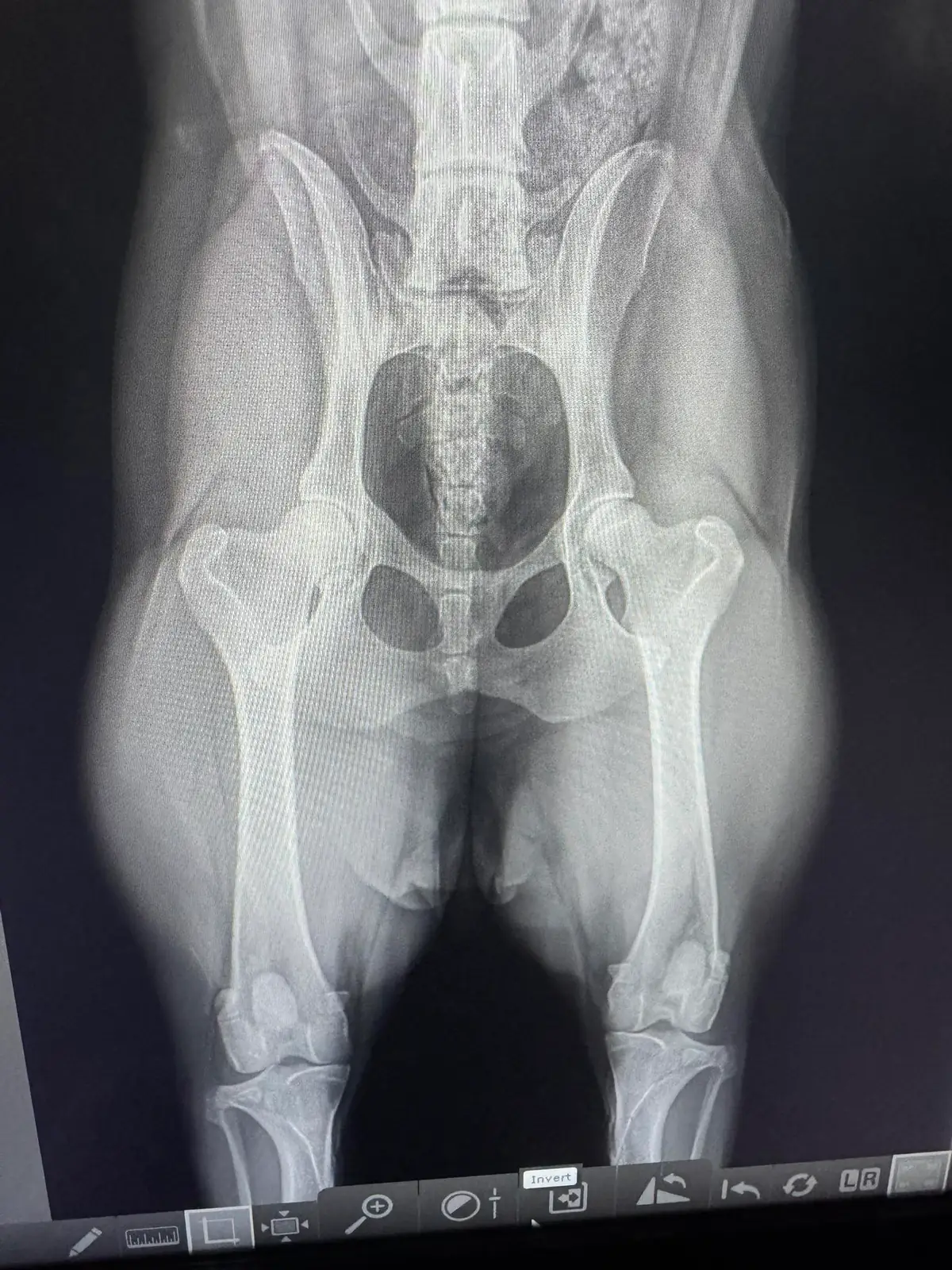
Here is how it actually works. The dog is sedated. The veterinarian positions the dog on the x-ray table in a very specific way — pelvis flat, legs extended and rotated to a precise angle — and takes a radiograph. The film is mailed (yes, the OFA still does paper submissions) to the OFA, where it is independently evaluated by three board-certified veterinary radiologists who have no idea who owns the dog. The three radiologists score the hips on a seven-point scale (Excellent, Good, Fair, Borderline, Mild, Moderate, Severe), and the consensus score becomes the dog's permanent, public OFA record.
This is the same process for elbows, scored as Normal or with Grade I, II, or III dysplasia. The films cannot be edited. The breeder cannot lobby for a better score. The radiologists cannot be bought. And the result lives on ofa.org forever, searchable by any member of the public.
Some breeders run "preliminary" hip and elbow films at 12 to 18 months. Prelims are useful — they give you an early read on a young dog before you have invested years in titling — but they are not a substitute for the final 24-month evaluation. A dog can prelim "Good" at 14 months and come back "Mild" at 24 months. The final films are what determine whether the dog will actually be bred. Anyone marketing a dog as "OFA tested" based on prelims alone is misrepresenting the work.
If a breeder cannot give you an OFA number, or asks you to take their word for the result, that is not OFA testing. It is a story about OFA testing. The whole point of submitting to the registry is that the result is no longer something a breeder can describe — it is something you can verify in thirty seconds at ofa.org.
CAER: The Eye Exam a Regular Vet Can't Do
The Companion Animal Eye Registry exam — formerly called CERF — is conducted by a board-certified veterinary ophthalmologist and screens for inherited eye conditions. A general practitioner vet does not perform CAER exams. There are only a few hundred board-certified veterinary ophthalmologists in the entire United States, and CAER exams typically happen at clinics that travel to dog shows, breed specialties, and regional eye clinics a few times a year.
The exam itself is quick — usually fifteen minutes — but it requires specialized equipment that a regular vet does not have. The ophthalmologist dilates the eyes and examines the retina, lens, and anterior structures for evidence of hereditary cataracts, Collie Eye Anomaly, persistent pupillary membranes, retinal dysplasia, and a long list of other conditions. The results are submitted to the OFA and published as part of the dog's CAER record.
It is worth noting that hereditary eye conditions can develop with age — hereditary cataracts in particular sometimes appear at three years, five years, or seven years in dogs whose eyes were perfectly clear at two. The OFA's CHIC database considers a CAER result current for twelve months, and many responsible programs re-check periodically across a dog's breeding career rather than treating a single exam as final. But the floor — the thing every breeding dog should have on file — is at least one CAER exam by a board-certified ophthalmologist, with results submitted to the OFA so they live alongside the dog's hip and elbow record.
You can verify a dog's CAER history the same way you verify OFA hips — by searching the dog's registered name at ofa.org and looking at the CAER section of the record.
CHIC: The Number That Ties It All Together
The Canine Health Information Center (CHIC) is run by the OFA in partnership with parent breed clubs. For each breed, the parent club specifies the panel of health tests required for a CHIC number. For Australian Shepherds, the CHIC requirements are: OFA hips, OFA elbows, CAER eyes (current, within the last year), and an MDR1 result. A dog who has cleared and submitted all of those — passing or failing, the CHIC number is awarded regardless of result, as long as the testing was done and submitted — earns a CHIC number.
That last detail matters. A CHIC number does not mean a dog passed every test. It means the dog completed every test and the results are on file. The actual results — the hip scores, the elbow grades, the eye findings, the genetic results — are published alongside the CHIC number and are publicly searchable. A breeder cannot earn a CHIC number for a dog and quietly hide a Mild hip score; the score is public.
The reason CHIC numbers are so useful is that they collapse a complicated verification process into a single number. Instead of asking the breeder to walk you through hips, elbows, eyes, and genetics one by one, you can ask: Does this dog have a CHIC number? If so, what is it? If the breeder cannot answer that question, the dog has not had the full breed-recommended workup. It is that simple.
Every dog in our program carries a CHIC number, and every result is published in full on our our girls and boys pages — hips, elbows, eyes, MDR1, full genetic panel, and the certificate images themselves. We do not just say the dogs are tested. We publish the receipts.
When Advanced Workups Come In
The four-test CHIC panel is the floor for Australian Shepherds. Beyond that, additional testing tends to happen on a case-by-case basis rather than as a uniform checklist applied to every dog. Some examples:
- A soft murmur picked up at a routine exam leads to a full echocardiogram by a board-certified veterinary cardiologist.
- An unusual gait or a question on a hip film leads to an orthopedic specialist referral and additional imaging.
- A line with a known history of a particular condition leads to additional targeted screening on a young dog before she is ever considered for breeding.
None of these advanced workups are cheap, and none of them are visible to the public. There is no single "extra credit" checklist that defines a serious program — what defines it is the willingness to follow up properly when something needs a closer look, rather than waving it off and breeding anyway.
For more on what the financial side of all this testing actually looks like across a breeding program, our companion post on what it really costs to breed Australian Shepherds responsibly walks through the numbers.
How to Verify Any Breeder's Claims in Five Minutes
This is the part of the post that we genuinely wish every Australian Shepherd buyer would internalize. Verifying a breeder's health testing claims is not hard. It does not require a veterinary background. It takes five minutes and an internet connection.
- Ask the breeder for the registered name of each parent dog. The registered name is not the dog's call name. It is the formal registered name on file with AKC, UKC, or ASCA — usually something like "SkyCreek's Chasing Celestial Dreams."
- Go to ofa.org and search that registered name.
- The dog's full health record will come up — hips, elbows, eyes, CHIC status, genetic test results, cardiac, patella, anything submitted to the OFA. If there is no record, the dog has no OFA testing on file.
- For genetic testing not submitted to OFA, ask the breeder to share the Embark for Breeders or UC Davis VGL report directly. Both produce shareable digital reports that take ten seconds to send.
- If a breeder cannot or will not give you registered names and verifiable results, that is your answer.
If you would rather watch us walk through this on a real dog's record, we filmed a short video showing how to verify a breeder's health testing through the OFA database — the whole thing takes about five minutes from start to finish.
This is not an aggressive ask. It is the most basic homework on a transaction that will shape the next twelve to fifteen years of your family's life. Every responsible breeder we know is glad when buyers do this. The breeders who get defensive are the ones whose claims do not survive a search.
Red Flags That a Breeder Isn't Actually Health Testing
Once you start looking, the red flags are easy to spot:
- "Vet checked" as a stand-in for health testing. A vet check is not the same product.
- "DNA tested" with no mention of which panel, no shareable report, or only a basic Wisdom Panel-style result.
- No registered names provided, or evasion when you ask for them.
- Prelim hips and elbows marketed as final results on a dog under 24 months.
- No CAER exam on file at all — at minimum, every breeding dog should have had at least one CAER from a board-certified ophthalmologist, with results submitted to the OFA.
- No CHIC number on a breed where the parent club has published clear CHIC requirements.
- Eye and hip results that the breeder describes verbally but cannot or will not produce documentation for.
- Health testing that exists for the female but not the stud — or vice versa. Both parents matter.
- Heavy use of "we don't believe in" language — we don't believe in OFA, we don't believe in over-testing, the dogs are healthy and that's what matters. This is the polite version of "we did not do the work."
A breeder who has done the work talks about it the way a homeowner talks about a recent renovation — specific, detailed, with documentation on hand. A breeder who is performing health testing through marketing only talks about it in vague, defensive generalities.
Why This Matters More Than Almost Anything Else
Health testing is the floor under everything else a breeder does. Without it, every other piece of breeder marketing — beautiful coats, lovely temperaments, structured socialization — is built on a foundation of guesswork. The temperament work in the world cannot fix a dog with severe hip dysplasia who will need a $7,000 total hip replacement at three years old. The beautiful color genetics do not matter when a dog goes into cardiac failure at five. The MDR1 mutation does not care whether you bought your puppy from a "small family breeder" or a kennel — if both parents were unscreened carriers, your dog has a 25% chance of carrying two copies of a mutation that will determine which medications are safe for the rest of its life.
The conditions health testing screens for are not exotic. They are the conditions that show up in Australian Shepherds at meaningful rates and that have been studied long enough to have evidence-based screening protocols. Skipping the testing does not eliminate the risk. It just transfers the risk to the puppy buyer, who finds out at three years old, or five, or seven, that the dog they planned to have for fifteen years has a condition that could have been screened for before he was ever conceived.
If you are evaluating breeders right now, our posts on how to choose a responsible Australian Shepherd breeder and why buying from a responsible breeder matters walk through the rest of what to look for. And if you want to see what fully published, third-party-verified health testing looks like in practice, every dog on our our girls and boys pages has their complete record on display — CHIC number, OFA results, eye exams, genetic panels, and the certificate images themselves. We do not ask you to take our word for any of it.
If you have questions about a specific test, a specific result, or what to ask another breeder, we are happy to talk. You can submit a puppy application or reach out directly and we will walk you through any of it.
Frequently Asked Questions
What is the difference between a vet check and health testing for breeding?
A vet check is a wellness exam — your veterinarian listens to the heart, palpates the abdomen, looks in the ears and mouth, and updates vaccines. It tells you whether the dog is currently sick. Health testing for breeding is a separate set of standardized, third-party-verified screenings (OFA hips, OFA elbows, CAER eye exam, and a comprehensive genetic panel) that screen for the heritable conditions known to affect a specific breed. A breeder who says their dogs are "vet checked" has not done health testing.
What does a CHIC number mean and why does it matter?
A CHIC (Canine Health Information Center) number is issued by the OFA when a dog has completed the full panel of breed-recommended health tests and submitted the results to the registry. For Australian Shepherds, that means OFA hips, OFA elbows, a current CAER eye exam, and an MDR1 result. A CHIC number does not mean the dog passed every test — it means the testing was done and the results are public. You can verify any dog's CHIC status and individual results by searching the dog's registered name at ofa.org.
Is a $99 Embark or Wisdom Panel DNA kit the same as health testing?
No. A consumer-grade ancestry kit screens for a limited set of genetic markers and is designed to identify breed makeup and a handful of common conditions. A breeder-grade panel — Embark for Breeders or UC Davis VGL — tests for the specific genetic conditions known to affect the breed (MDR1, HSF4, CEA, PRA, HUU, DM, and others), verifies parentage, and is the kind of report a responsible breeder will share with you directly. Either way, genetic testing alone is not health testing. It does not detect hip dysplasia, elbow dysplasia, hereditary cataracts that develop with age, or cardiac conditions.
Can I really verify a breeder's health testing claims myself?
Yes, and you should. Ask for the registered name of each parent dog and search it at ofa.org. The dog's full health record will appear — hips, elbows, eyes, CHIC status, genetic results — if those tests have actually been submitted to the registry. If no record appears, the testing the breeder is claiming was not submitted to OFA. Genetic test reports from Embark for Breeders or UC Davis VGL can be shared by the breeder digitally in seconds. A responsible breeder will be glad you asked.
What if a breeder says they "don't believe in" OFA testing?
This is one of the most common ways breeders explain away the absence of health testing. There are dogs who genuinely cannot be tested for medical reasons — a dog with a prior injury that affects positioning, for example — but a breeder who is uniformly skeptical of OFA is not telling you about their philosophy. They are telling you they did not do the work. The OFA process exists precisely because individual breeders' assessments of their own dogs are not reliable, and the breeders most resistant to independent verification are the ones whose results would most benefit from it.
What does health testing cost a breeder per dog?
A core CHIC-aligned panel — OFA hips, OFA elbows, a CAER eye exam by a board-certified ophthalmologist, and a comprehensive breeder-grade genetic panel — typically runs $800 to $1,500 per dog at minimum, before any follow-up CAER exams, advanced workups, or condition-specific imaging. That cost is multiplied across every dog in the program, including the prospects who never end up being bred. Our companion post on what it really costs to breed Australian Shepherds responsibly breaks down the full picture.