An undercover investigation published by Vox this year sent a Mercy For Animals investigator to work for roughly two and a half months at a USDA-certified organic chicken farm in North Carolina — one that raises birds for Pilgrim's Pride, which slaughters them and sells the meat to Costco and other brands. What the investigator documented on the inside was ugly: unsanitary living conditions, birds with twisted necks and open wounds, a farm manager who left injured animals to die slowly in deadpiles, and birds euthanized by bludgeoning with PVC pipes and rakes. Mercy For Animals' own reporting on the same investigation adds that chicks were crushed and buried alive and that biosecurity failures at the farm raised public health concerns. The farm confines up to 520,000 birds at a time and turns out roughly 3.2 million pounds of chicken a year — all of it sold under a label that customers pay nearly double for, in part because they believe it means something better for the animal.
It was Mercy For Animals' second exposé of Costco's chicken supply chain in five years. The first, in 2021, led to public commitments from Costco to improve welfare standards. Reading the new investigation, it's hard not to ask what those commitments actually changed on the ground.
We're not writing this to pile on one retailer or one contract grower. Costco didn't invent this system — it processes chicken at a scale (over 250 million birds a year across its supply network) that simply isn't possible without it, and it buys from the same handful of large, vertically integrated poultry companies that supply most of the country. That's the point. This is what the system looks like almost everywhere, once you get past the label on the package.
This Isn't a Bad Apple. It's the Business Model.
Modern commercial poultry production is built around a handful of pressures that all point the same direction: grow more birds, faster, on less space, for less money.
Broiler chickens have been bred for decades to reach market weight in about six to seven weeks — roughly triple the growth rate of a chicken from the 1950s. That kind of growth puts enormous strain on a bird's skeleton and heart; it's a big part of why investigators keep finding birds who can barely stand. Flocks are housed by the tens or hundreds of thousands in a single barn. Growers are often contract farmers who don't own the birds and operate on thin margins set by the company they supply, which leaves little room to slow down or hire more help even when conditions call for it.
And the labels meant to signal something better — organic, humane-certified, cage-free — are, in practice, paperwork standards. They describe what's supposed to happen, not what a third party is watching happen every day. An investigator can walk onto a certified organic farm and find birds who, by the investigator's account, never once had the outdoor access the certification requires. The label isn't lying, exactly. It's just describing a standard, not a guarantee.
None of this requires anyone to be a villain. It's just what happens when cost is the only variable that matters.
Why We Raise Ours Differently
We raise chickens too — a few hundred at a time, not half a million. Ours live outdoors from the day they're big enough to handle it, in mobile shelters we physically move to fresh grass every single day. That's not a marketing detail; it's the whole point. Moving them daily means they're always on clean ground with fresh forage and bugs to eat, it means their manure gets spread evenly across the pasture instead of pooling into a waste problem, and it means we're looking at every bird, every day, because we're the ones dragging the shelter across the field.
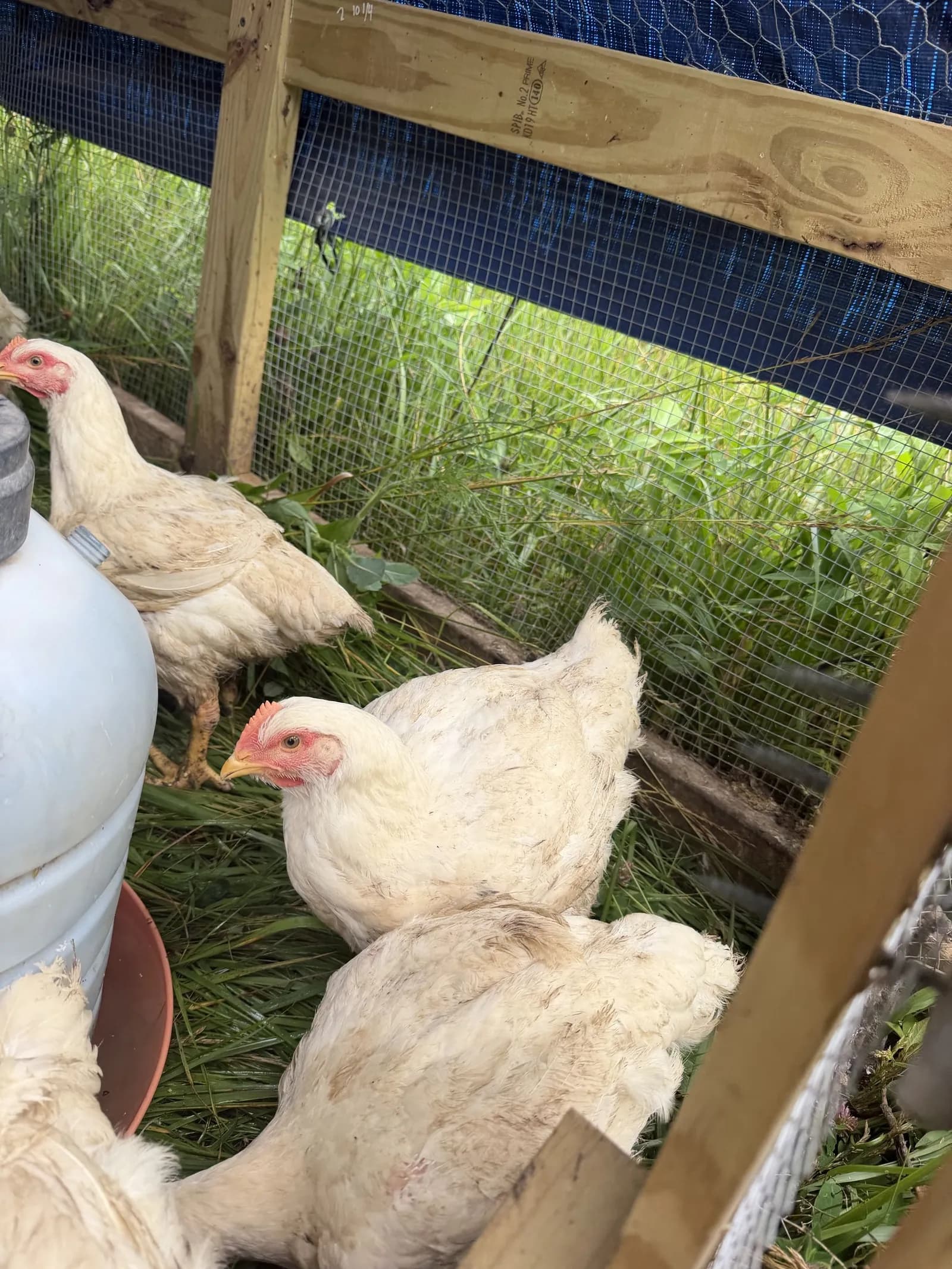
We don't use routine antibiotics, because we don't need to — birds on fresh ground in small groups don't get sick the way birds packed into a barn do. There's no deadpile to manage discreetly, because there isn't a group of birds large enough, or hidden enough, for that to happen unnoticed.
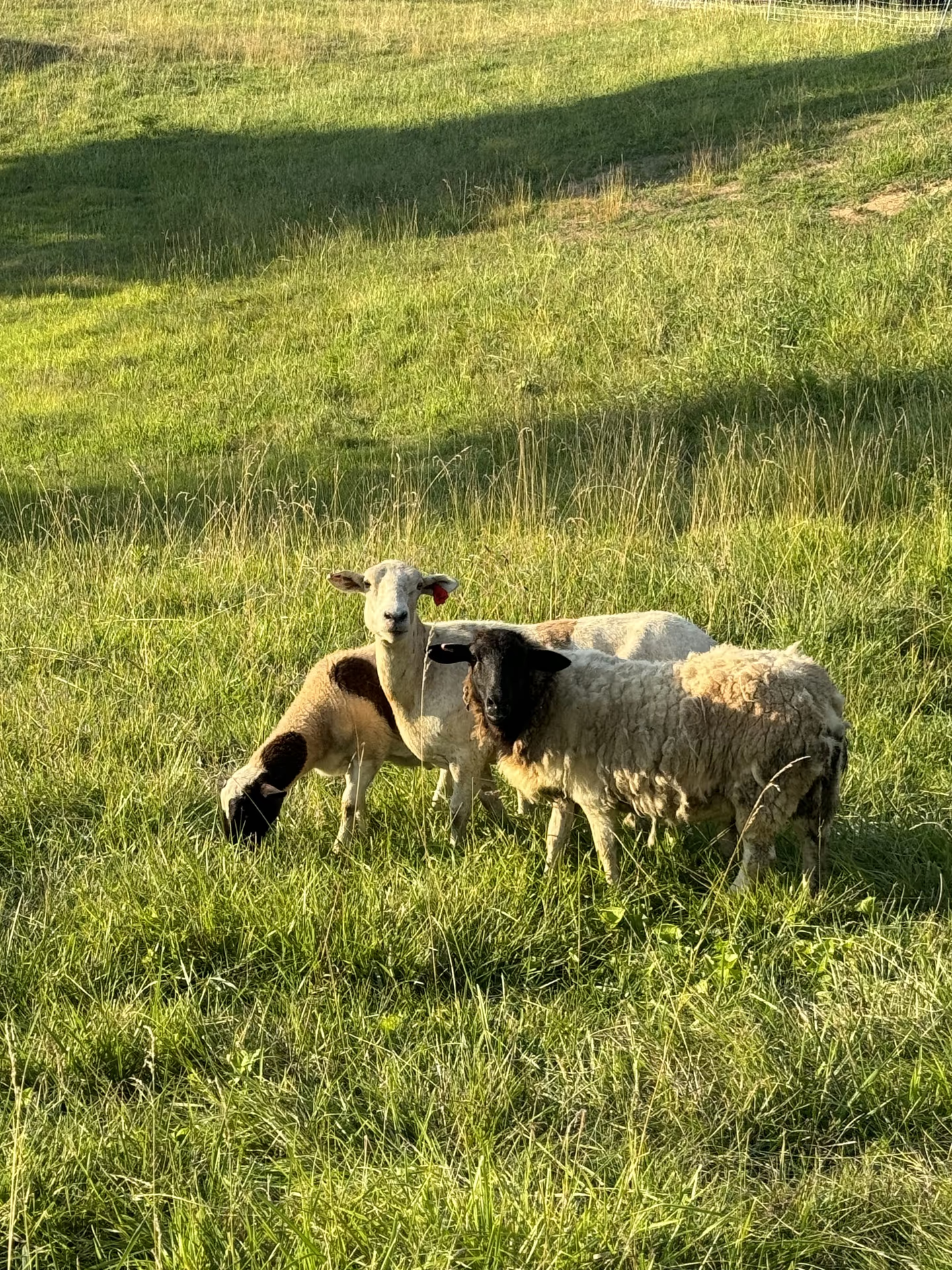
When it's time, our animals are processed at a small, family-run, USDA-inspected facility about 45 minutes from the farm — not a plant running thousands of birds an hour. Every package we sell can be traced back to the specific pasture and week it came from. This same philosophy is how we raise our pastured pork and grass-fed lamb too: rotational grazing, animals living in the environment they're built for, and nothing about the process we'd be uncomfortable showing you.
What "Pasture-Raised" Should Actually Mean
Here's the uncomfortable truth about food labels: almost none of them are illegal to misrepresent in spirit, even when they're technically accurate. "Cage-free" can still mean tens of thousands of birds in one building. "Free-range" can legally mean a small door to a concrete pad that most of the flock never uses. Even "organic" — the label at the center of this investigation — is a feed and inputs standard, not a promise about how an individual bird is treated day to day.
The only label that actually means something is the one you can verify yourself: a farm that will tell you exactly what it feeds, how often it moves its animals, and where it processes them — and that will let you come see it. That's not a regulatory category. It's just how we've chosen to operate, because it's the only version of "pasture-raised" we'd want to eat ourselves.
"Certified Humane" Labels Are Mostly a Marketing Layer
Here's the part that should really give you pause: the farm at the center of this investigation wasn't hiding from oversight. It was certified humane by American Humane, one of the larger animal-welfare certification bodies in the country. When the video surfaced, American Humane's response was that it has "zero tolerance for animal cruelty and abuse" and would be launching its own investigation — which is another way of saying its own audit process didn't catch any of this.
That's not really a scandal about one certifier. It's how nearly all third-party welfare and organic certifications work. The company being certified pays the certifying body for the audit and the right to put the seal on its packaging — a financial relationship that runs in the wrong direction if the goal is a truly independent check. Audits typically happen once a year, and they're scheduled in advance, which means everyone involved knows exactly which day to have things looking right. What gets reviewed is mostly paperwork and formulas — square footage per bird, feed inputs, outdoor-access minutes on paper — not a camera running for the other 364 days.
None of that means every certified farm is faking it, or that every certification program is a scam. Plenty of them raise the floor somewhat, and that's worth something. But a logo on a package is a policy, not a promise, and it's a much weaker signal than most shoppers assume when they pay a premium for it. It's also exactly the kind of claim a small farm can't fake — because we don't have a scheduled annual audit day. We have every day, and anyone is welcome to show up on one.
How to Actually Know Where Your Meat Comes From
If this kind of investigation makes you want to change how you buy chicken, the good news is that you don't need to take anyone's word for it — including ours. A few things worth doing:
- Ask the farm direct questions. How many birds are in a flock? How often are they moved? What happens to sick or injured animals? A real answer sounds specific. A vague one is a red flag.
- Visit if you can. Farmers markets exist for exactly this reason — it's a lot easier to be honest about how you farm when your customers can walk the pasture.
- Understand what labels actually guarantee, and what they don't. A label tells you a farm met a paperwork standard once a year. It doesn't tell you what a Tuesday looks like.
- Buy direct from small producers when you can. Shorter supply chains mean fewer places for a gap between the label and reality to hide.
We sell pasture-raised chicken, pork, and lamb by the cut, and we're glad to answer any question about how it's raised — see our current cuts here, or find us at a local farmers market.
Frequently Asked Questions
What did the Costco chicken investigation actually find?
An investigator with the nonprofit Mercy For Animals spent roughly two and a half months undercover at a USDA-certified organic chicken farm in North Carolina that raises birds for Pilgrim's Pride, which supplies Costco and other brands. As reported by Vox, the investigation documented unsanitary conditions, birds with twisted necks and open wounds, a farm manager leaving injured birds to die slowly in deadpiles, and birds euthanized by bludgeoning with PVC pipes and rakes — plus, per Mercy For Animals' own account, chicks crushed and buried alive and violations of organic outdoor-access requirements. It was Mercy For Animals' second such investigation of Costco's chicken supply chain in five years.
Is this specific to Costco, or does it reflect the industry as a whole?
It reflects the industry as a whole. The farm in this investigation supplied Pilgrim's Pride, one of a handful of large, vertically integrated poultry companies that supply most of the grocery chains and restaurant brands selling chicken in the U.S. — Costco included. The underlying model behind what investigators found — huge contract-grown flocks, fast growth, thin third-party oversight — is standard across commercial poultry production, not a one-retailer problem.
What actually makes pasture-raised chicken different from what's in a grocery store?
Scale and daily practice. Our chickens live in small flocks on open pasture, in mobile shelters we move to fresh grass every day, with no routine antibiotics and no confinement housing. A commercial "cage-free" or even "organic" label can still describe tens of thousands of birds in a single barn. The difference isn't the words on the package — it's what's actually happening in the field, which is something we're happy to show anyone who asks.
How is Queen City Farm's chicken processed?
At a small, family-run, USDA-inspected facility about 45 minutes from our farm in Falmouth, Kentucky — not a high-volume industrial plant. Every package we sell is properly labeled and traceable back to the specific pasture and week it came from.