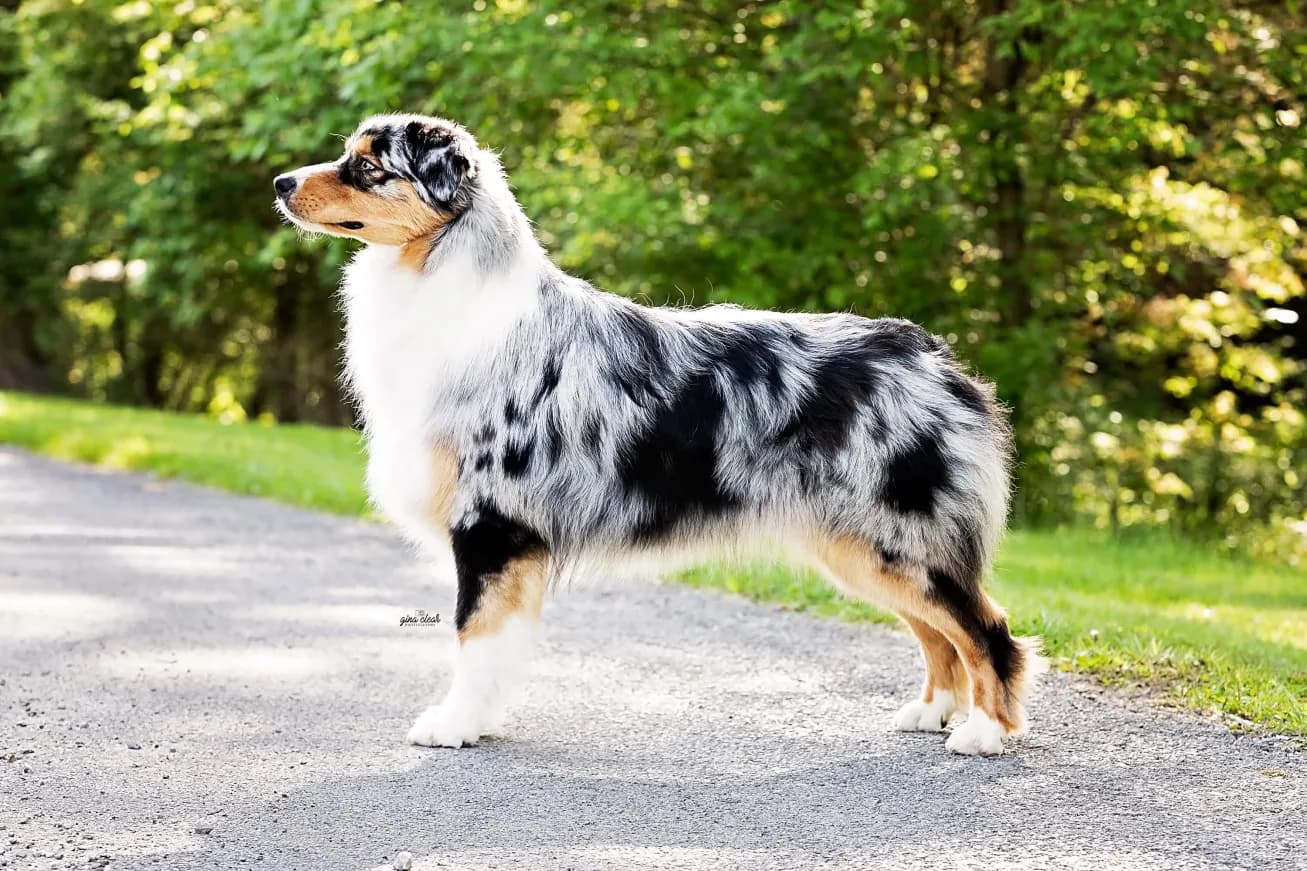
It is one of the most common questions we hear from families waiting on a litter: how many puppies do Australian Shepherds actually have? It is a fair thing to wonder, whether you are hoping to reserve a puppy or just curious about the breed. The short answer is straightforward, but the full picture has more nuance than most people expect — and we can speak to it from our own whelping box.
The Short Answer
An Australian Shepherd litter is typically six to seven puppies. The normal range runs from roughly four to nine, though litters as small as a single puppy and as large as eleven or twelve do happen. Aussies are a medium-sized breed, and litter size tends to track with body size, so they land comfortably in the middle — larger than a toy breed, smaller than a giant one.
That said, "average" hides a lot of variation. Plenty of healthy, well-bred litters fall on either side of that number, and a count outside the typical range is not automatically a cause for concern.
What a "Normal" Litter Looks Like
Our own litters have run on the larger side of normal — nine puppies in our Thanksgiving litter and ten in our May Flowers litter. Both were healthy, full litters from dams in good condition, which is exactly the pattern you tend to see: a well-conditioned mother in her prime years often carries a fuller litter.

What Affects How Many Puppies a Dog Has
Litter size is not random. Several factors influence it, which is why two Australian Shepherds can produce very different numbers:
- The dam's age. Litter size often peaks when a female is in her prime, roughly three to five years old, and can taper off in her later years.
- The dam's size and build. Within the breed, a larger, deeper-bodied female often carries more puppies than a smaller one.
- Genetics and bloodline. Some lines simply tend toward bigger or smaller litters, and that pattern often repeats across generations.
- Health, nutrition, and condition. A dam in excellent condition with proper nutrition is set up to conceive and carry a healthy litter.
- Breeding timing. Breeding in tight alignment with the female's ovulation — confirmed by progesterone testing — gives the best chance of a strong conception and a fuller litter.
- The sire. Fertility and semen quality on the male's side matter just as much as the female's.
Timing the Breeding Can Mean a Fuller Litter
Of all the factors above, timing is the one a breeder has the most control over — and it can make a real difference in litter size. A female is only fertile for a narrow window, and breeding too early or too late means fewer eggs get fertilized, which means fewer puppies.
That is why we use progesterone testing to pinpoint ovulation. A series of simple blood draws tracks the dam's rising progesterone and tells us, often down to the day, when she is at peak fertility. Breeding squarely into that window gives the largest possible number of eggs the best chance of being fertilized.
This is also where artificial insemination earns its place. Once progesterone testing has dialed in the timing, a freshly collected sample can be delivered and placed during that narrow peak — sometimes the same day it is collected — so the semen is at its most viable exactly when the dam is most fertile. Precise timing paired with a fresh, well-handled sample is one of the most reliable ways to support a strong conception and, with it, a fuller litter.

How Do Breeders Know How Many Puppies Before They Are Born?
This is where good veterinary care comes in. A responsible breeder does not simply wait and count on whelping day — knowing the expected number ahead of time helps us prepare and lets us know when a delivery may not be finished. There are three common tools:
- Palpation — around day 28, a veterinarian can sometimes feel the developing puppies, which confirms pregnancy but is not a reliable head count.
- Ultrasound — performed around three to four weeks, ultrasound confirms pregnancy and checks viability and heartbeats, but it is not accurate for counting because puppies overlap and move.
- X-ray — this is the reliable count. Once the puppies' skeletons have mineralized, usually around day 45 and later, an x-ray in the final week or so of pregnancy lets a veterinarian count spines and skulls with good accuracy.
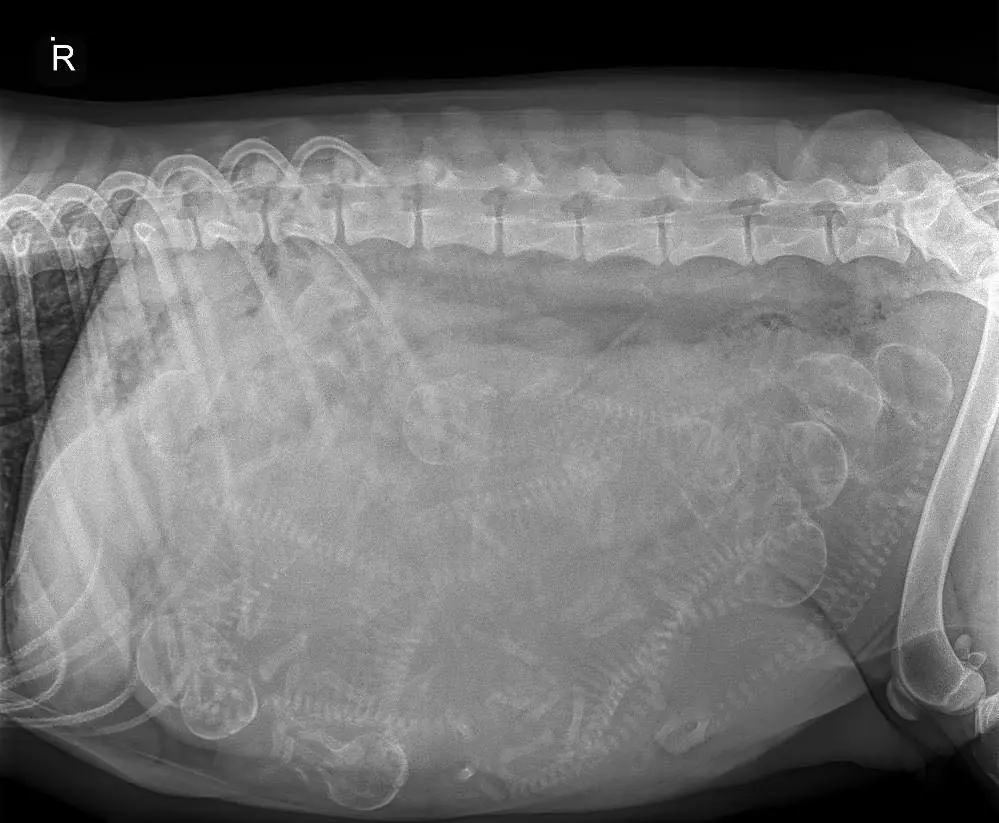
That x-ray count is also a safety tool. If a dam delivers six puppies but the x-ray showed seven, we know to keep watching and call our veterinarian rather than assuming she is finished.
Bigger Is Not Always Better
It is tempting to think a huge litter is a great thing, but more puppies is not automatically better. Very large litters can mean smaller birth weights, a mother stretched thin trying to feed everyone, and more hands-on work — supplemental feeding, careful weight tracking, and round-the-clock monitoring to make sure no puppy gets left behind.
A big litter can also make whelping itself riskier. A dam delivering a large litter is more likely to tire before she is finished, and crowding in the womb raises the odds of a puppy being mispositioned or labor stalling — a difficult birth that can require veterinary help or an emergency cesarean section. It is one more reason we watch every delivery closely and keep our veterinarian on call.
Singletons and very small litters have their own challenges too, including a puppy who misses out on the lessons that littermates teach one another. What matters far more than the number is the care behind it: a thoughtfully planned breeding, a healthy dam, and a breeder who is present for every puppy. If you want a sense of everything that goes into that, our post on what it really costs to breed responsibly lays it out.

However many puppies arrive, our job is the same: give each one the same intentional start. You can read about that in how we raise our puppies.
Frequently Asked Questions
How many puppies do Australian Shepherds have in a litter?
Australian Shepherds typically have six to seven puppies per litter, with a normal range of roughly four to nine. As a medium-sized breed, their litter size lands in the middle — larger than a toy breed and smaller than a giant breed. Healthy litters do fall on both sides of that average, so a count a little higher or lower is usually nothing to worry about.
How many puppies can an Australian Shepherd have at once?
While six to seven is typical, an Australian Shepherd can have as few as one puppy or as many as eleven or twelve. Very large litters are less common and tend to come from larger, well-conditioned dams in their prime years. They also require more support from the breeder, since more puppies can mean lower birth weights and a mother who needs help keeping everyone fed and thriving — and a higher chance of a difficult birth or an emergency cesarean section.
Can you increase an Australian Shepherd's litter size?
You cannot guarantee a larger litter, but good breeding practices give a dam the best chance at a full one. The biggest lever is timing: progesterone testing pinpoints ovulation so the breeding lands in the female's peak fertility window, when the most eggs are available to be fertilized. Pairing that precise timing with a fresh, well-handled sample — often through artificial insemination — helps make conception as strong as possible. Beyond timing, a dam in excellent health and condition is best set up to conceive and carry a healthy litter.
Do first-time Australian Shepherd moms have smaller litters?
Not reliably. It is a common belief, but litter size is driven far more by the dam's age, size, genetics, condition, and breeding timing than by whether it is her first litter. Plenty of maiden dams have full litters right out of the gate — our own first litter was nine puppies. A first-time mom can have a large litter or a small one, so being a first litter alone is not a dependable predictor.
How can you tell how many puppies a dog is having before they are born?
The most accurate method is an x-ray taken in the last week or so of pregnancy, once the puppies' skeletons have mineralized — usually around day 45 and later — which lets a veterinarian count spines and skulls. Ultrasound earlier in the pregnancy confirms that the dam is pregnant and checks the puppies' heartbeats, but it is not reliable for counting. Knowing the expected number ahead of whelping is an important safety check that tells the breeder when a delivery is complete.
Is a bigger litter better?
Not necessarily. A large litter is not inherently healthier or more desirable than a small one. Bigger litters can mean smaller birth weights, a dam who needs help feeding everyone, and a riskier delivery — large litters carry a higher chance of a difficult birth or an emergency cesarean section. Very small litters and singletons have their own challenges too. What matters most is the quality of the breeding and the care each puppy receives — not the number of puppies in the box.